Gutters protect your foundation by carrying rainwater away from your home before it can soak the soil around your walls. Every time it rains, your roof collects a large volume of water. If gutters and downspouts don’t move that water away, it pools around the foundation and slowly causes structural damage.
This guide explains how gutters affect your foundation, the warning signs of drainage problems, what gutter installation and repair involve, and when to call a professional in Fayetteville, Bentonville, Rogers, Springdale, and Bella Vista.
How Gutters Affect Your Foundation
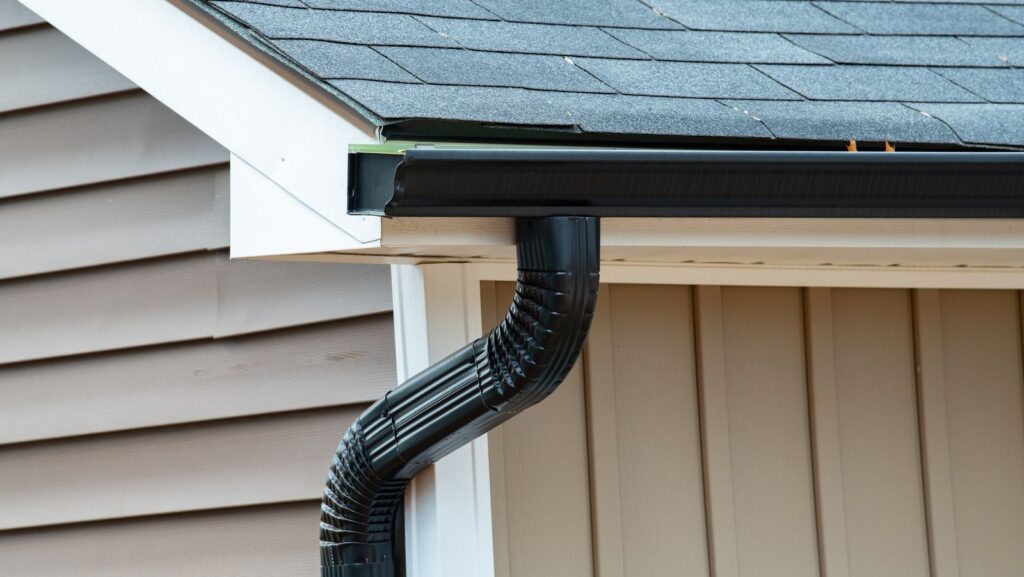
A gutter system collects roof runoff and directs it through downspouts to a safe discharge point. When it works properly, water lands several feet from your foundation walls. When it fails, water drops straight down along the foundation.
Roof runoff is heavy. A rainstorm sends hundreds of gallons off an average roof. Without gutters, that water falls in a concentrated line along your walls.
Saturated soil puts pressure on the foundation. Wet soil is heavier and exerts hydrostatic pressure against basement and crawl space walls. Over time, this causes horizontal cracks, bowing walls, and leaks.
Clay soil makes it worse. Much of Northwest Arkansas has clay-rich soil that swells when wet and shrinks when dry. Repeated cycles can shift the soil beneath a slab or footing, leading to settling, uneven floors, and cracks.
Erosion undermines support. Water pouring off an overflowing gutter can wash away soil near the footing, which reduces the support your foundation depends on. The same process can damage retaining walls and surrounding structures.
Warning Signs Your Gutters Are Hurting Your Foundation
Check for these indicators after the next heavy rain:
- Water overflowing the gutters or streaming over the edges
- Gutters pulling away from the fascia or sagging
- Standing water or muddy patches within a few feet of the foundation
- Soil erosion or small trenches under downspouts
- Stains, peeling paint or mildew on exterior walls
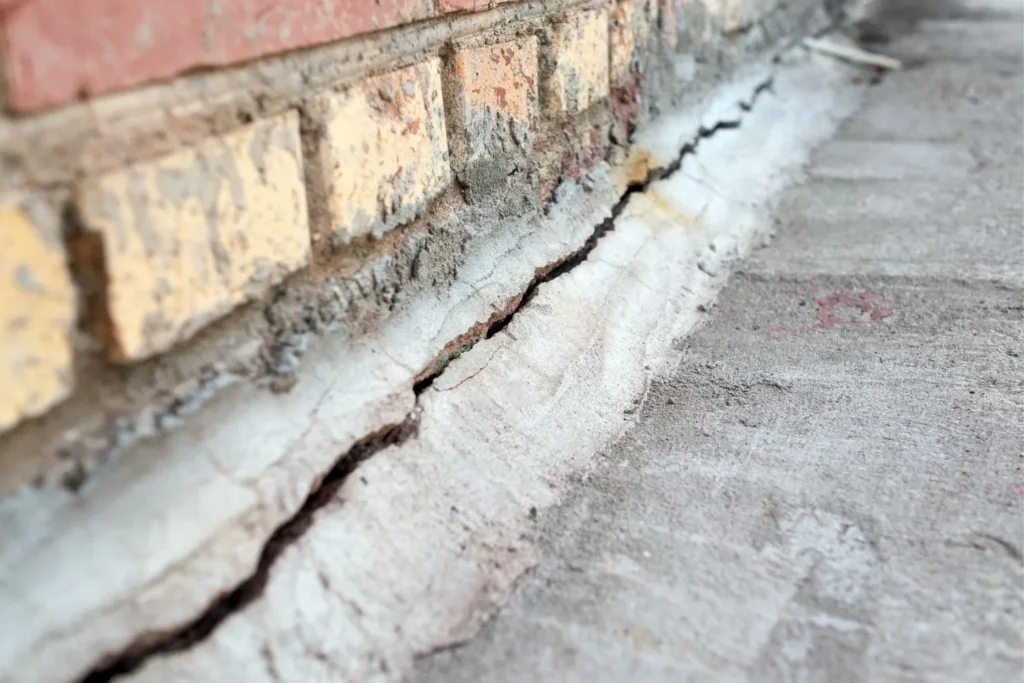
- Hairline or stair-step cracks in brick, block or concrete
- Damp basement walls, a musty smell or efflorescence (white mineral deposits) on concrete
- Doors and windows that stick or no longer close properly
- Cracks or gaps in concrete patios, walkways and driveways
Several of these overlap with the 10 warning signs your home needs foundation repair. If you see more than one, it’s worth getting an inspection.
Common Gutter Problems That Lead to Foundation Damage
- Clogs from leaves, shingle grit and debris. This is the most common cause of overflow, especially for homes near trees.
- Incorrect slope. Gutters need a slight pitch toward the downspout. Without it, water sits and overflows.
- Too few or poorly placed downspouts. Long gutter runs need enough downspouts to handle the volume.
- Short downspouts that discharge at the foundation. A downspout that ends right at the wall defeats the purpose of the system.
- Loose, rusted or leaking seams. Older sectional gutters often leak at the joints.
- Undersized gutters. Some roofs need larger gutters or more capacity for heavy rain.
Drainage Fixes That Protect Your Foundation
Extend downspouts. A widely used guideline is to discharge water at least 4 to 6 feet from the foundation, and farther if your lot slopes toward the house.
Regrade the soil. The ground should slope away from the foundation so water naturally flows outward.
Use splash blocks or buried drain lines. Buried lines carry water to a safe outlet such as a lower part of the yard or a drainage area.
Install seamless gutters. Continuous gutters have fewer seams, so there are fewer places to leak.
Add gutter guards where appropriate. Guards reduce debris buildup, though no guard eliminates the need for periodic inspection.
Consider exterior drainage or waterproofing. If water is already reaching the foundation, gutters alone may not be enough. Foundation waterproofing handles water that is already in the soil.
Gutter Installation Cost: What Affects the Price
There is no single price, because several factors affect the total:
- Linear footage: the longer the roofline, the higher the cost
- Material: aluminum, steel, copper, and vinyl vary widely in price and lifespan
- Seamless vs. sectional: seamless gutters are custom-formed on site
- Home height and roof complexity: two-story homes and multi-angle roofs take more labor
- Number of downspouts and extensions
- Gutter guards or underground drainage add-ons
- Removal of old gutters and repairs to damaged fascia
The cost of new gutters is usually far less than the cost of repairing foundation cracks or waterproofing a wet basement. For comparison, see how much foundation repair costs.
Repair or Replace?
Repair is usually enough when damage is limited to a few loose hangers, a small leak, or a localized clog.
Replacement makes sense when gutters are rusted through, repeatedly leaking at the seams, sagging along most of the run, or too small to handle your roof’s runoff.
How Gutters, Waterproofing and Concrete Leveling Work Together
Water management is not a single-service problem. Often the right fix combines several:
- Gutters control water from the roof
- Waterproofing protects the foundation from water already in the soil
- Foundation repair corrects cracks, settlement, and structural movement
- Concrete leveling lifts sunken slabs, walkways, and driveways, which often settle because of poor drainage
A contractor who handles all of these can diagnose the real source of the problem instead of treating only the symptom.
When to Call a Professional
Call for an inspection if you notice recurring overflow, pooling near the foundation, cracks that are growing, a damp basement or crawl space, or sinking concrete. A professional can check gutters, grading, drainage and the foundation in one visit.
Precision Foundation Specialists serves homeowners in Fayetteville, Bentonville, Rogers, Springdale and Bella Vista. Contact us or call (479) 225-4899 for a free estimate.
Frequently Asked Questions
Can bad gutters really damage a foundation?
Yes. Gutters that overflow or discharge near the walls saturate the soil, which can lead to cracks, settlement, leaks, and erosion.
How far should a downspout extend from the house?
A common recommendation is at least 4 to 6 feet away from the foundation, adjusted for your lot’s slope.
How often should gutters be cleaned?
At least twice a year, and more often if you have overhanging trees. Check them after major storms.
Do gutter guards stop foundation problems?
They reduce clogs, but the system still needs correct slope, enough downspouts and proper discharge.
Are gutters enough to fix a wet basement?
Not always. If water is already seeping through walls or floors, you may also need waterproofing or drainage work.
Is gutter repair cheaper than foundation repair?
In nearly all cases, yes. Preventing water problems costs much less than fixing the structural damage they cause.